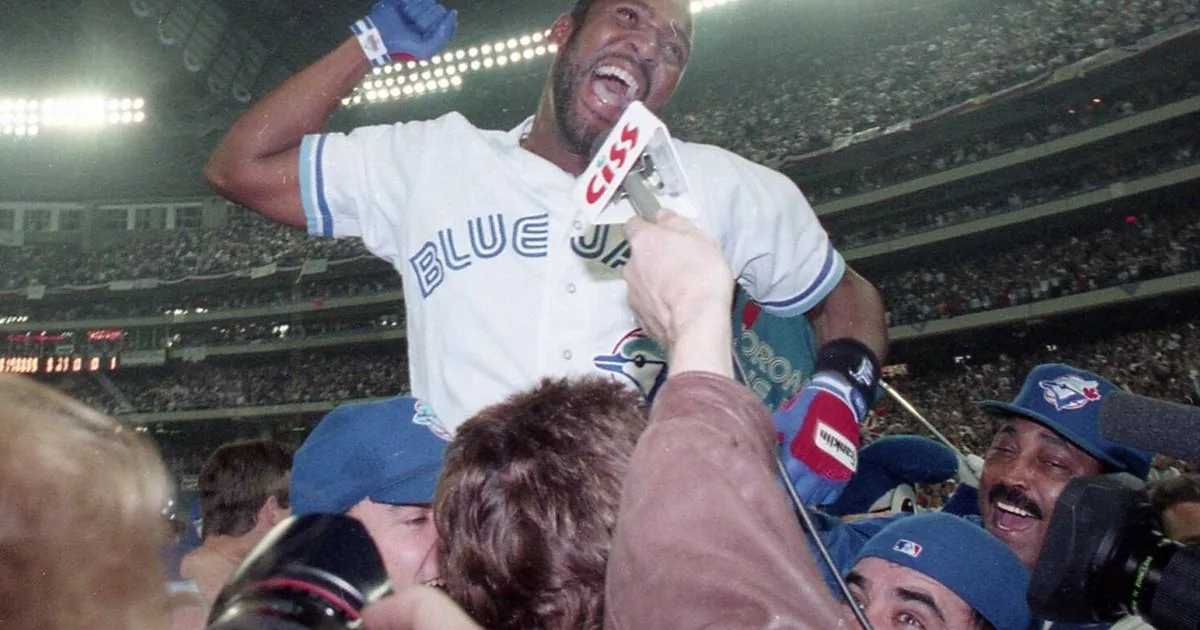

A new statue commemorating the Toronto Blue Jays‘ 1992 and 1993 World Series championships has been unveiled outside the Rogers Centre. The monument features Joe Carter, the team’s right-fielder, in mid-jump as he rounds the bases following his walk-off home run that secured the 1993 World Series victory. This addition is situated at the southeast corner of the ballpark, specifically outside Gate 5.
The statue’s creation is part of the franchise’s celebration of its 50th anniversary. The unveiling event saw nearly 30 alumni from the two championship teams in attendance. Among the notable former players present were Joe Carter himself, 1992 World Series MVP Pat Borders, and 1993 World Series MVP Paul Molitor.
This new installation replaces a previous statue that honoured former Blue Jays owner Edward S. Rogers, who passed away in 2008.
Celebrating Distinct Championship Teams
The two championship teams, though linked historically, were constructed in notably different ways. Both squads played under the management of Cito Gaston, achieving their titles independently. The 1992 Blue Jays recorded 96 regular-season wins, while the 1993 Blue Jays secured 95 regular-season victories.
The 1992 and 1993 teams are being celebrated with this statue, acknowledging their talent, determination, and the significant influx of new players. Despite wearing the same uniforms, the rosters were not simply a continuation from one year to the next.
A substantial portion of the 1992 team’s plate appearances, more than 2,800 out of 6,224, were made by players who were no longer with the team the following season, representing approximately 45 per cent. Similarly, over 594 of the 1,440 innings pitched by the 1992 pitching staff, about 41 per cent, were by players who had departed after October.
While a core group of players remained, including Roberto Alomar, John Olerud, Joe Carter, Devon White, Jack Morris, Juan Guzman, Todd Stottlemyre, Duane Ward, and Pat Borders, many others moved on. Notable departures included Dave Winfield, Candy Maldonado, Kelly Gruber, Manny Lee, Jeff Kent, Derek Bell, and Pat Tabler. On the pitching side, Jimmy Key, David Wells, Dave Stieb, Tom Henke, Bob MacDonald, and David Cone were among those who left.
The Impact of New Additions in 1993
The 1993 team saw significant additions that contributed to its success. Among the new arrivals were Hall of Famer Paul Molitor, who joined as a free agent, and Rickey Henderson, acquired at the trade deadline. Other key additions included Tony Fernández, Darnell Coles, Darrin Jackson, and Dick Schofield Jr.
The pitching staff was bolstered by Dave Stewart, Danny Cox, Woody Williams, and Tony Castillo. Dave Stewart, known for his strong presence, provided a captivating influence for the younger players, similar to the impact Jack Morris had upon his arrival the previous year.
Internal promotions also played a crucial role. Ed Sprague significantly increased his plate appearances and became the primary third baseman. Pat Hentgen moved into the rotation, winning 19 games and increasing his innings pitched from 50 to 216. Duane Ward took over as closer and received votes for the Cy Young award after Tom Henke‘s departure.
John Olerud had a standout season at first base, leading the league with 211 hits and winning the batting title with a .363 average. He also recorded 54 doubles and an OPS of 1.072, finishing third in the MVP voting with 7.8 WAR, which was 1.6 WAR higher than the MVP winner, Frank Thomas.
Paul Molitor, a cerebral player, was motivated by a desire for a championship ring, having last been in the post-season in 1982 when his team lost the World Series. He understood his role was to largely replace Dave Winfield as the designated hitter. Molitor led the league with 211 hits, finished second in MVP voting, and batted .500 in the World Series to earn the MVP award.
The general manager, Pat Gillick, managed to retain valuable players while bringing in new talent. Analysis indicates that only 30 per cent of the team’s hitting WAR and 27 per cent of the pitching WAR from the 1992 season departed, suggesting a strategic approach to roster adjustments. These two distinct championship teams are now recognized with a statue outside the Rogers Centre.
Read Also
Source: toronto.citynews.ca

Ethan Brule is a Senior Hockey Writer at CasinoNews. He covered the NHL for a national Canadian outlet. He focuses on the NHL, the Maple Leafs and Team Canada and is known for clear, deadline-driven reporting. He holds a degree in Sports Media from Toronto Metropolitan University. Now based in Toronto, he plays beer-league hockey and follows the junior ranks. “Hockey in Canada is never only about the score.”